About us
Discover the history of El Carmen de Rojas
Since 1837, El Carmen de Rojas has witnessed part of Argentina’s history. Discover how this place became a refuge of quiet, tradition and countryside hospitality.
A bit of history
The name “El Carmen de Rojas” dates back to 1837.
The first owner of these lands was Juan Evangelista Cano Castro, who obtained large tracts of land through emphyteusis and had them surveyed between 1826 and 1838. In 1839, he received the deed for 20,978 hectares. Juan was married to Carmen Díaz Vélez, with whom he had several children. In 1866, Carmen requested the survey of the lands received by the minor Susana Cano, the natural daughter of Marciano Cano, who recognised her in his will and made her a beneficiary of his estate. Susana inherited a fraction of 5,408 hectares where several outposts were located, among them “El Carmen”.
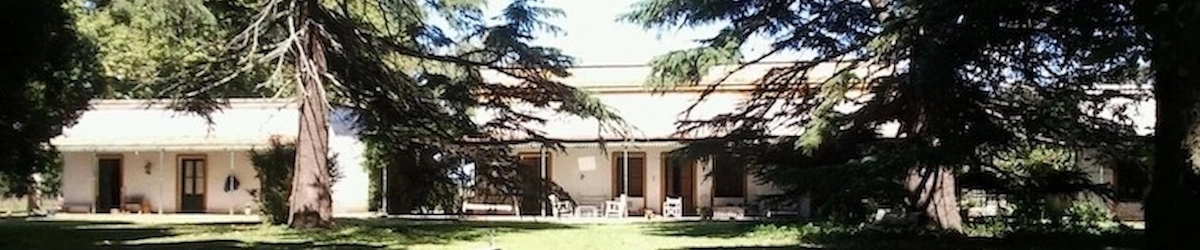
The main house had three construction stages: the oldest part dates from 1850, it was expanded in 1870 and renovated in 1910 to its current form. In 1915, brothers Otto Eduardo and Federico Otto Bemberg acquired the estate and created “Colonia El Carmen”.
Later, it was expropriated by Banco de la Nación Argentina on September 17, 1948, by decree No. 27,842, dividing its more than 5,000 hectares.
(We thank researcher Marcelo E. Álvarez Herrera for the information provided.)

My personal story
My name is Marian Solveyra, and I inherited the farm from my mother, Randi Rostad, who was Norwegian.
I lived here until I was five years old, when we moved to Buenos Aires so I could attend an English school. I hated going from the countryside to an apartment in Belgrano. I always wanted to come back. I studied at Northlands School in Olivos. Still, because my father, Guillermo Solveyra, had a racehorse stud farm here, which operated until 1998, I returned by train every weekend.
I am a landscape designer and English teacher, and I want to share the sad part of what happened to my mother 20 years ago. My mother was living at the farm when she was unexpectedly murdered, in circumstances that have still not been fully clarified. I was pregnant with Isabella and, carrying all that pain, I took charge of the estate. My mother was already separated from my father, Solveyra. Since then, as an only child and heir to the farm, I have leased the productive part. Since January 2021, I also decided to open the gates to welcome guests.

I am Olivia
My name is Olivia Messere. I am Marian’s daughter, and I inherited my mother’s love for the countryside.
I study at the agricultural technical school in Hunter, and my plan is to study production technology. But perhaps I will dedicate myself to horses. I love them, and I work with them every day. When neighbouring towns hold national celebrations or parades, I am often invited to participate with one of the horses from El Carmen. Sometimes I go alone with a horse, but I usually invite a friend.
We moved permanently to the farm four years ago, when my sister went to study in Rosario. Since then, we have worked every day to improve each corner of a farm that is almost bicentennial. I take care of collecting and selling eggs in trays of 30 units in Rojas. I have had a sow since my first year at school, and I invite you to meet her because she is very tame. I am also usually the one who organises the horseback rides and teaches guests a little if they do not know how to ride.
A glimpse into our history
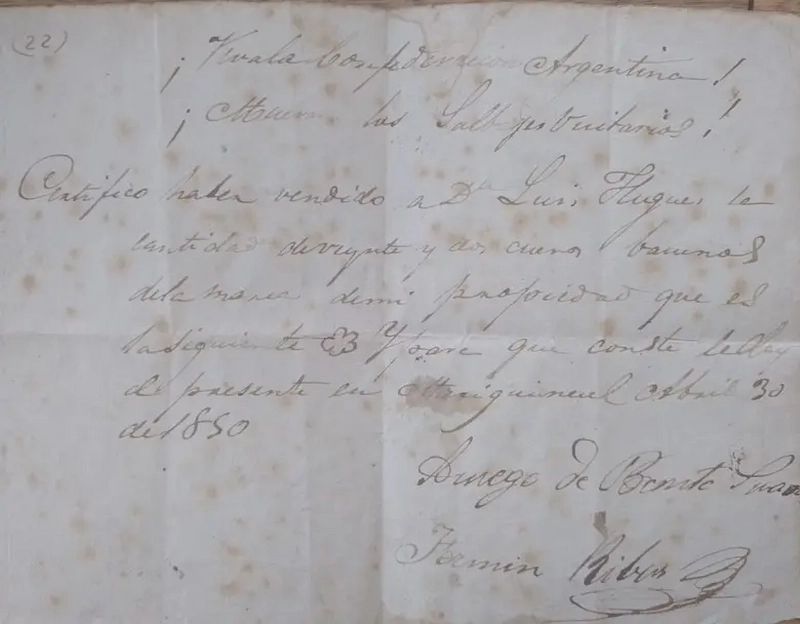
A note that is part of Argentine history
“Long live the Argentine Confederation! Death to the savage Unitarians! I certify that I have sold to Don Luis Hugues...” This is how a hide-sale note begins, issued between 1831 and 1852, when that heading was used as part of the mandatory divisa punzó. The note was found in the main house.
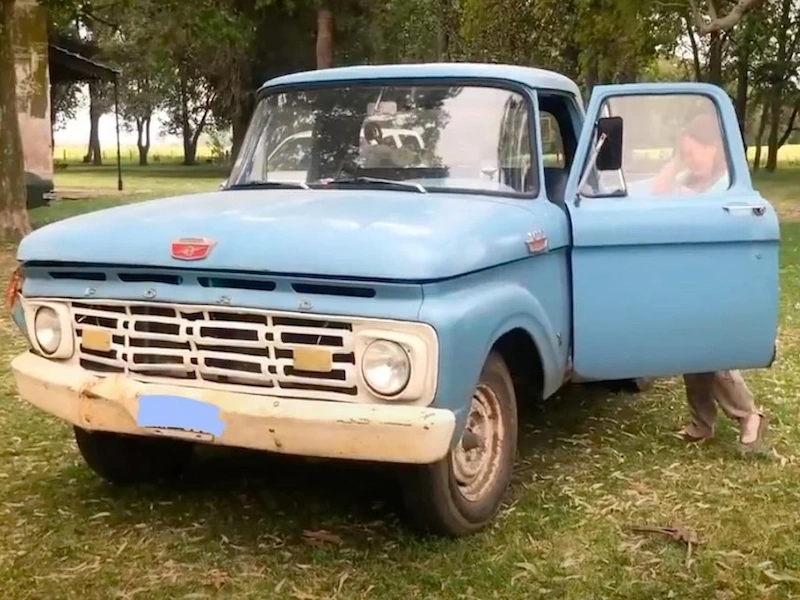
A symbol: the 1962 Ford F100
A vehicle lovingly preserved through the decades has become a symbol of the countryside. It never lets you down, is as strong as an oak and ready for every task. It has served for many decades, and we still use it around the area and for rides with selected guests.
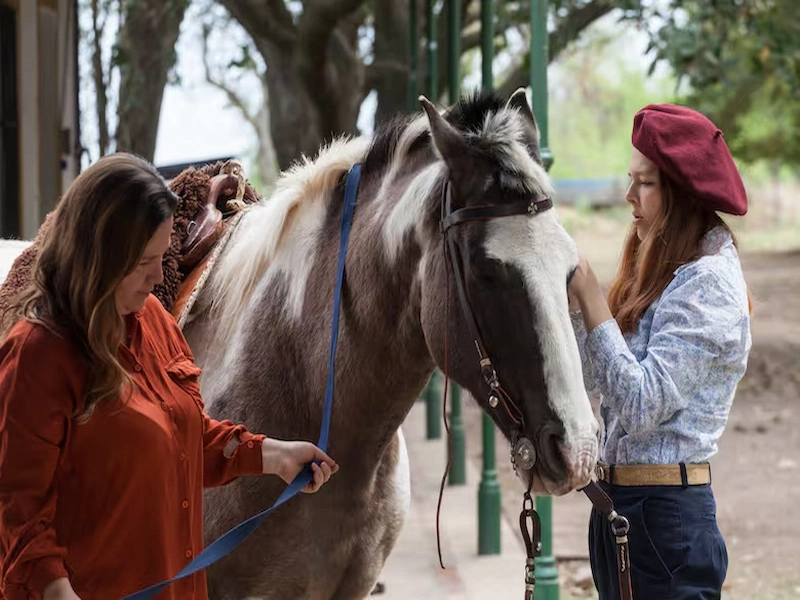
Rural traditions
Marian and Oli are involved in every detail of hospitality. The gaucho saddle is the traditional Argentine saddle and usually includes a sweat pad, mandil, carona, bastos with leather stirrup straps and buckle, cinch, cojinillo and rawhide pegual.
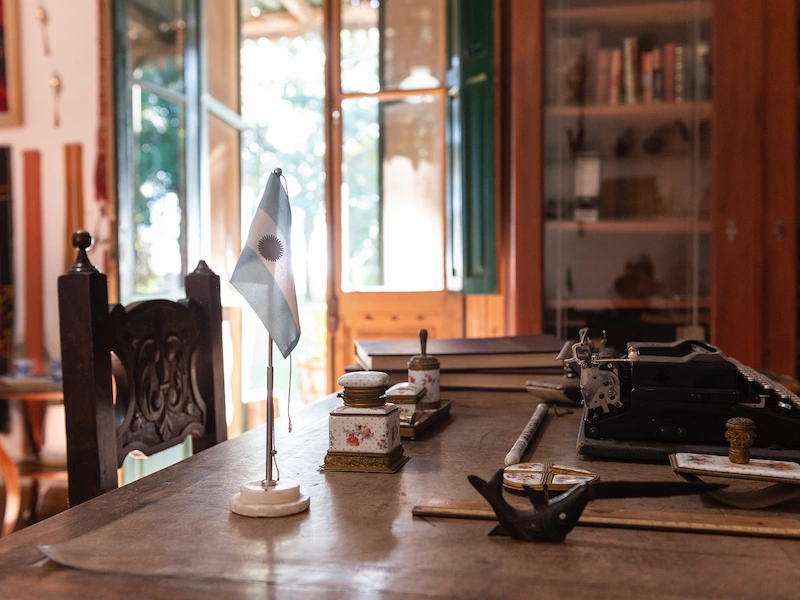
Corners with history
The walls of the original house are made of adobe and are approximately 50 cm thick, with ceilings over 6 metres high. These features provide thermal insulation that is still appreciated. In summer, simply closing doors and windows keeps the house cool.